
5 small shifts to turn creativity into a daily wellness practice
Unlocking Your Inner Innovator: Five Pillars of Daily Creativity
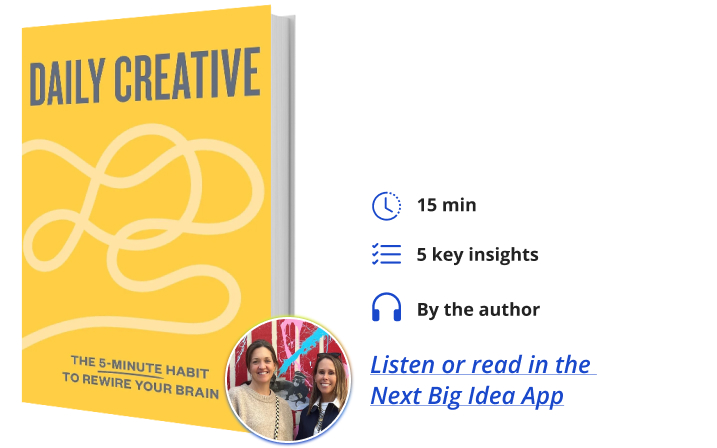
Creativity isn't a rare gift bestowed upon a select few; it's an inherent human capacity that flourishes with consistent practice. Authors Blythe Harris and Mallory May, in their book "Daily Creative: The 5-Minute Habit to Rewire Your Brain," challenge the notion that creativity is solely about artistic achievement. Instead, they champion it as a vital daily wellness practice that can profoundly enhance well-being, foster mental flexibility, and cultivate a more vibrant sense of being alive. Harris, an artist and entrepreneur who previously co-founded and led Stella & Dot, now partners with May at Daily Creative, where their mission is to demystify and integrate creativity into everyday life.
The core philosophy is simple yet transformative: when we approach creativity as a small, consistent habit rather than a high-pressure performance, it becomes an accessible and powerful tool for personal growth.
1. Creativity: A Muscle to Be Exercised, Not a Talent to Possess
A pervasive myth suggests that creativity is an innate talent – you either have it or you don't. Harris and May argue persuasively that this couldn't be further from the truth. Creativity functions much like a muscle: it strengthens with regular use and weakens with disuse. While the capacity for creativity is inherent in all of us, it requires consistent nourishment and practice to thrive. When we neglect it, creativity doesn't vanish; it simply lies dormant.
Many individuals who claim, "I'm not creative," haven't actually lost their creative spark. More often, they've adopted a fixed mindset, likely stemming from an early negative experience involving judgment or shame. Perhaps a teacher's disapproval of a poem or a childhood drawing that was deemed subpar led to a decision to abandon creative pursuits. Over time, the perceived safety of creative expression diminished, leading to opt-out.
However, the authors have observed that when creativity is reintroduced as a low-pressure, playful, and small-scale practice, people quickly re-establish a connection. True confidence in one's creative abilities doesn't arise from being inherently "good" at it; it emerges from consistent, fearless engagement.
2. The Power of Small Acts: Catalyzing Meaningful Mental Shifts
We often mistakenly believe that significant change necessitates substantial time commitments or Herculean efforts. Yet, the human brain frequently responds more powerfully to consistency and novelty than to sheer duration.
Engaging in brief creative activities, particularly when they are approached with playfulness and without judgment, can effectively disrupt habitual thought patterns and open the door to fresh perspectives. The objective isn't to produce more or to achieve perfection. The simple aim is to engage frequently enough to maintain mental agility.
Many individuals report feeling a subtle but significant shift after even seemingly unproductive creative sessions. The feeling of being "slightly more open, more awake" is precisely the kind of change that matters. Creativity's effectiveness isn't contingent on its impressiveness.
3. Creativity as a Cornerstone of Well-being
While creativity is often associated with self-expression, its impact on mental and emotional health is profound. Research indicates that engaging in creative activities can enhance brain plasticity, alleviate stress and anxiety, and cultivate cognitive flexibility and open-mindedness. Furthermore, consistent creative engagement has been linked to improved memory function and may even play a role in protecting against cognitive decline as we age.
What's particularly fascinating is the overlap between the benefits of creative practices and those of meditation. Both can lead to increased calm, presence, and emotional regulation. However, creativity often feels more accessible and enjoyable, removing the pressure to "quiet the mind" and instead inviting a different form of engagement.
Many individuals discover a sense of calm, clarity, or groundedness following creative endeavors, regardless of the perceived outcome. Creativity offers a unique avenue for processing experiences indirectly, bypassing the need for immediate explanation, analysis, or problem-solving. In this light, creativity transforms from a focus on output to a practice of self-care.
4. Dismantling Perfectionism: The Antidote to Creative Blockage
Perfectionism acts as a formidable barrier to creativity by narrowing focus and intensifying self-monitoring, both of which actively hinder creative thought processes. One of the most effective strategies for rekindling creativity involves intentionally lowering the stakes.
Introducing simple constraints, embracing repetition, or establishing clear starting points effectively shifts attention from the final outcome to the generative process. Instead of posing the question, "Is this good?" the brain begins to explore, "What happens if I try this?"
The authors have repeatedly witnessed this phenomenon: when individuals are given a straightforward guideline, such as drawing with their non-dominant hand or working within a defined grid, the pressure immediately dissipates. This liberation allows for experimentation, spontaneous laughter, and the joy of self-discovery. Releasing the grip of perfectionism is not an unchangeable personality trait; it's a skill that can be cultivated through practice.
5. Embracing Aliveness: Creativity Beyond the Product
At its heart, creativity is not defined by what is produced, but rather by how one engages with the world. Many people describe an enhanced sense of aliveness following creative moments – feeling more present, more connected, and more authentically themselves. This feeling of vitality doesn't necessitate innate talent or specialized training. It stems from the conscious reintroduction of curiosity and mindful attention into the fabric of daily life.
Creativity, in this profound sense, isn't something to be earned; it is something to be allowed. It's an invitation to experience life with a renewed sense of wonder and engagement.



Post a Comment for "5 small shifts to turn creativity into a daily wellness practice"